Custom Foam Inserts for Cases
Custom foam inserts for cases are precision-cut foam interiors engineered to hold specific equipment, tools, or components in place inside a protective case. They solve three problems at once: damage prevention during transport and storage, organization that speeds access and accountability, and presentation quality that reflects the professionalism of the product inside.
Platt Cases manufactures custom foam inserts for OEMs, industrial buyers, field service teams, and product managers who need repeatable production. Typical programs run from 10 to 100+ units, with design files archived for reorders that match the original specification exactly.
To request a quote: provide the case brand and model number or interior dimensions, an item list of everything that goes inside, the use scenario (shipping, field, storage, or presentation), and the target quantity. Platt Cases handles design, prototyping, and production from there.
See also: Custom Products | Custom Foam Overlay
What Are Custom Foam Inserts Used For?
Custom foam inserts serve four primary functions — and the best programs often combine more than one. Each use case maps to a specific operational value that justifies the investment in a custom-fit solution over generic foam or empty case interiors.
Tool Control and Shadow Foam
Shadow foam — also called two-tone foam — is a layered insert in which a brightly colored base layer is exposed when a tool is removed from its pocket. The visual contrast makes missing tools immediately obvious at a glance, without requiring a manual count.
Primary environments: maintenance crews, field service teams, industrial production floors, calibration labs, and any environment where tool accountability or FOD (Foreign Object Damage) control is required.
Two-tone foam eliminates the time spent at the end of the shift searching for missing tools and creates a visual record of kit completeness that can be audited without opening a manifest. For OEM programs, it ships the customer a professional, accountable kit from day one.
Protection for Sensitive Equipment
Custom-cut foam pockets eliminate movement during transport — the primary cause of damage to sensitive equipment. Tight pocket geometry prevents the equipment from shifting, contacting case walls, or rattling against adjacent components during vibration and impact events.
Shock absorption is determined by foam density and material selection. Polyethylene foam provides firm, load-bearing protection for heavy equipment. Polyurethane convoluted foam absorbs vibration in lid applications. For electronics, ESD-safe foam prevents electrostatic discharge damage that standard foam cannot address.
- Abrasion control: tight pocket walls prevent surface-to-surface contact that scratches coatings and lenses
- Orientation control: pocket geometry enforces correct placement — the equipment can only go in one way
- Protrusion accommodation: foam pockets are cut around handles, connectors, and raised features
Inventory Management and Kitting
Organized foam cavities give each component a defined home, which makes kit counts faster, more reliable, and trainable across multiple users. When every item has a specific pocket, a missing component is visible immediately — without a checklist.
Presentation and Demo Cases
A custom foam insert transforms a protective case into a product presentation platform. Precisely shaped pockets hold equipment at consistent angles, cable bundles are routed cleanly, and the interior communicates the same attention to quality as the product itself.
For demo and sales kits that travel frequently, foam durability matters as much as appearance. Polyethylene and XLPE foam maintain their shape and surface appearance through repeated open/close cycles that compress softer foams over time. Fabric-capped inserts add a premium surface finish for high-value presentation programs.
Types of Foam Inserts for Cases
Foam material selection determines protection level, weight, durability, surface finish, and per-unit cost. Each material has a specific role in custom foam case programs — and choosing the wrong one is the most common source of field failures and premature insert replacement.
| Foam Type | Best Application | Key Trade-off |
|---|---|---|
| Polyethylene (PE / EPE / XLPE) | Industrial, field use, rugged protection programs | Heavier than PU; firmer feel |
| Polyurethane (PU) | Lid lining, light cushioning, lower-frequency use | Compresses faster under daily open/close use |
| Anti-static / ESD | Electronics, sensors, calibrated equipment | Required spec — not interchangeable with standard foam |
| Fire-resistant / MIL-SPEC | Defense, aerospace, and regulated transport programs | Requirements-driven — specify compliance standard upfront |
| Two-tone / laminated / fabric-capped | Tool control, labeling, and premium presentation | Add fabrication steps; cost scales with complexity |
Polyethylene (PE / EPE / XLPE) Foam Inserts
Polyethylene foam is the standard material for rugged, industrial custom foam case programs. Its closed-cell structure resists moisture absorption, maintains shape under compression, and holds pocket geometry accurately across the life of the insert — even in environments where the case is opened and closed multiple times per day.
- Expanded PE (EPE): firm, load-bearing, standard density range for most industrial applications
- Cross-linked PE (XLPE): tighter cell structure, superior chemical and moisture resistance, preferred for medical and clean-room programs where material traceability is required
- Best for: OEM shipping programs, field service kits, tool control inserts, and any program where the insert must maintain dimensional accuracy across hundreds of open/close cycles
Polyurethane (PU) Foam Inserts
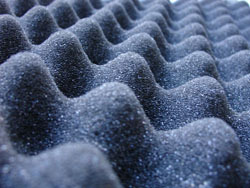
Polyurethane foam is the most common lid liner and light-cushioning material in protective cases. Its open-cell structure provides good vibration damping at low cost and is available in convoluted (egg-crate) profiles that increase surface contact area for irregular equipment shapes.
- Best for: lid lining, lightweight equipment cushioning, cases that are opened occasionally rather than daily
- Limitation: PU compresses and loses shape faster than PE under repeated use — for high-frequency field programs, PE or cross-linked PE is more cost-effective over the program lifespan
Anti-Static and ESD Foam Inserts
ESD-safe foam is a functional specification, not a cosmetic option. Standard polyethylene and polyurethane foam can generate and hold electrostatic charges that damage electronics, PCBs, sensors, and calibrated assemblies on contact. Specifying ESD foam eliminates that risk.
Three ESD foam classifications — specify the correct one:
Anti-Static
Dissipates surface charges; prevents charge buildup on the foam itself — not rated for component-contact protection
Static-Dissipative
Controlled discharge rate; appropriate for component-contact pockets in most electronics applications
Conductive
Rapid discharge path; used when direct grounding is required in the foam itself
Fire-Resistant and MIL-SPEC Foam Options
Fire-resistant and MIL-SPEC foam materials are requirements-driven selections for programs with regulatory or contractual obligations — not general-purpose upgrades. Applications include defense transport, aerospace ground support equipment, and programs subject to specific compliance standards.
If a program has fire-resistance, off-gassing, or material specification requirements, provide the relevant standard (e.g., MIL-PRF-26514, FMVSS 302) at intake. Platt Cases will specify and source the correct material for the program.
Two-Tone, Laminated, and Fabric-Capped Foam
Two-tone foam laminates a brightly colored base layer (typically red, orange, or yellow) beneath a primary foam layer. When a tool or component is removed, the base color is exposed — creating an immediate visual indicator of a missing item without any counting required.
- Laminated foam combines layers of different densities or materials for programs that need base-layer shock absorption with a surface-layer finish or ESD property
- Fabric-capped inserts add a sewn textile surface to foam pockets, providing a premium appearance and abrasion protection for polished surfaces. Routed plastic caps can be added to cavity edges for labeling, color-coding, and long-term durability in high-wear tool control applications
Custom Foam Inserts for Pelican Cases
Platt Cases designs and manufactures custom foam inserts for Pelican cases and other major protective case brands. As an authorized Pelican dealer, Platt Cases supplies both the case and the custom foam insert as a complete program — one vendor, one design process, one production run.
Custom foam inserts for Pelican cases are designed to the exact interior dimensions of each Pelican model, including base depth, lid depth, and any existing latching or divider channel geometry that affects the foam footprint. Foam is cut to fill the interior completely, with equipment pockets positioned for the correct orientation and access pattern.
Pelican custom foam inserts work across the full Pelican product line, including the 1510, 1520, 1610, 1620, 1650, Storm series, and Air series cases. Provide the model number and Platt Cases will design to the correct interior specification.
What We Need to Fit Foam to Your Pelican Case Model
| Input Required | Why It Matters |
|---|---|
| Case brand and model number | Sets the interior dimensions — base depth, lid depth, and total footprint for the foam design |
| Interior dimensions (if model is unknown) | L × W × H of base and lid separately — measure inside the gasket seal, not the case exterior |
| Equipment list and dimensions | All items packed, including cables and accessories — incomplete lists are the most common cause of post-prototype redesigns |
| Use scenario | Shipping, field deployment, travel, or lab storage — determines foam density and pocket geometry requirements |
| ESD or compliance needs | Must be specified before foam is designed — not retrofittable after the insert is cut |
How Custom Foam Inserts Are Made
Platt Cases produces custom foam inserts through a structured four-stage process with buyer approval points before each major commitment. No production foam is cut until a first-article insert is approved by the buyer.
Consultation and Requirements
The process begins with a review of the submitted equipment list, case model, and use scenario. Platt Cases identifies any specification gaps — missing accessory items, unclear orientation constraints, or unspecified ESD requirements — before design begins. Catching gaps at this stage prevents redesign after prototype.
- Output: confirmed equipment list, case model, and interior dimensions, use scenario, foam material recommendation, and initial layout approach
Foam Layout Design
The foam layout is designed in CAD based on the confirmed equipment list and protection requirements. Pocket geometry is engineered for the correct fit tolerance — tight enough to prevent movement during transit, with clearance for protrusions and orientation constraints. Finger pulls, cable routing channels, label recesses, and multi-layer tray systems are incorporated into the design at this stage.
- Buyer review and approval of the foam layout drawing is required before cutting begins
- CAD files are versioned and archived — approved designs can be reordered to the same specification without a new design cycle
Waterjet Cutting and Quality Control
Approved foam inserts are cut on waterjet equipment, which produces consistent pocket geometry across every unit in the production run. Waterjet cutting eliminates the hand-trim variation that causes fit inconsistencies between units — every insert in a 500-unit run is cut to the same tolerance as the prototype.
- QC checks at cutting: pocket dimensions, layer alignment, and surface finish are inspected against the approved drawing
- Fit verification: inserts are checked against the actual equipment or case model before production quantities are completed
Delivery, Replacement Inserts, and Program Support
Completed inserts are packaged and shipped to the buyer's specified destination. For OEM programs shipping to multiple locations, Platt Cases coordinates split shipments and just-in-time delivery against production schedules.
Design files are archived at Platt Cases for the life of the program. Replacement inserts for wear, version updates when equipment changes, and reorders for additional production runs are fulfilled against the archived specification without requiring a new design cycle or first-article prototype.
Design Features That Improve Usability
A well-designed custom foam insert is engineered for the workflow of the people who use it — not just for the protection requirements of the equipment inside. These features reduce damage risk, speed field operations, and extend the functional life of the insert across a full production program.
Finger Pulls, Hand Grabs, and Easy Removal
Equipment that is difficult to remove from foam pockets gets damaged during removal — not during transit. Finger-pull channels routed alongside equipment pockets allow users to lift components cleanly without tilting, prying, or gripping coated surfaces.
- Especially relevant for: field service kits opened under time pressure, demo cases operated by non-technical sales personnel, and programs where the same equipment is removed and replaced dozens of times per week
- Tray systems use web strapping or metal handles to allow full layers to be lifted out as a unit — particularly useful for high-part-count kits or multi-user environments
Labels, Routing, and Visual Organization
Routed label recesses, two-tone color contrast, and cavity numbering systems allow users to identify components by position at a glance — without reading part numbers or referring to a packing list. This is particularly valuable in multi-user environments where standardized re-packing is a training and audit requirement.
- Plastic caps on cavity edges provide durable, cleanable label surfaces in high-use tool control applications
- Two-tone foam provides missing-item visibility without labels — the base color is exposed the moment a component is removed
- Color-coded foam sections organize multi-component kits into logical groups — primary equipment, accessories, consumables
Multi-Layer Inserts and Tray Systems
When part counts exceed what fits in a single foam layer, stackable tray systems allow full kits to be packed into a single case without sacrificing pocket accuracy or organization. Each tray lifts out as a complete layer, providing access to the layer below without unpacking the entire case.
- Tray handles: web strapping or metal handles allow single-handed tray removal, even when the case is in a tight space
- Layer identification: routed or printed tray numbers or color coding ensures trays are replaced in the correct order after use
- Depth optimization: tray thickness is calibrated to the tallest item in each layer, minimizing total stack height and keeping the case lid closed cleanly
Industry Solutions
Custom foam inserts for cases serve different operational requirements across industries. The right foam type, pocket design, and usability features depend on what the insert is protecting, who is using it, and what conditions it operates in.
Electronics and Medical Device
- Low-abrasion foam surfaces: cross-link PE and fabric-capped inserts protect lens coatings, instrument calibration surfaces, and polished housings from abrasion during insertion and removal
- ESD foam: static-dissipative or conductive foam is required for PCBs, sensors, test equipment, and any assembly with exposed conductors — standard foam is not an acceptable substitute
Industrial Equipment and Tool Storage
- Tool accountability: two-tone shadow foam provides immediate visual confirmation of kit completeness without counting or checklists
- Rugged handling: PE and XLPE foam withstand repeated drops, temperature variation, and exposure to industrial lubricants and cleaning agents better than open-cell alternatives
- Heavy equipment: foam density is matched to the weight and fragility of the specific equipment
Sales, Demo, and Presentation
- XLPE foam holds its color, surface texture, and pocket geometry through repeated demo use better than polyurethane
- Fabric caps add a premium textile surface to foam pockets — appropriate for high-value instruments, jewelry, cosmetics, and any product where the case is part of the sales experience
- Cable management: routed cable channels and document pockets keep presentation kits organized so the sales representative opens to a clean interior every time
Shipping, Storage, and Transit
- Pocket fit tolerance: tight pockets prevent movement without requiring so much force to insert and remove the equipment that it creates a different damage risk
- Layer density: base foam density is calculated for the drop height and vibration profile of the intended transport mode (air, ground, common carrier)
What Information Do We Need to Quote and Design Your Foam Inserts?
Providing complete intake information eliminates back-and-forth before design begins and reduces the number of revision cycles before prototype approval.
| What to Provide | Details |
|---|---|
| Case | Brand and model number (e.g., Pelican 1510, SKB 3I-1309-6) — or interior dimensions (L × W × H base and lid separately) if brand/model is unknown or a custom shell |
| Items | Complete list of everything that goes in the case: primary equipment dimensions and weight, all accessories (cables, chargers, adapters, manuals, consumables), and any items that vary by kit configuration |
| Photos or CAD | Photos of the equipment and accessories — or CAD files (STEP, IGES, SolidWorks) if available. Even phone photos accelerate the design process significantly |
| Use scenario | Primary use: shipping, field deployment, storage, or presentation. Note handling conditions: drop risk, temperature range, moisture exposure, frequency of open/close use |
| Protection needs | ESD requirements (anti-static, static-dissipative, or conductive), IP rating needs, MIL-SPEC or compliance standards, and fragile surfaces that must not be contacted by foam |
| Quantity | Prototype run quantity and target production volume — both affect material selection, manufacturing method, and per-unit pricing |
| Timeline | Needed-by date for first article (prototype) and full production delivery. Note any phased rollout milestones |
| Shipping destination | Final destination for completed inserts and whether they are shipped installed in cases or as loose inserts for customer installation |
Request a Quote for Custom Foam Inserts for Cases
Ready to get started?
Platt Cases manufactures custom foam inserts for OEM programs, industrial buyers, field teams, and product managers who need precision fit, repeatable production, and program support from 10 to 100+ units. To get started, provide:
- Case brand and model number (or interior dimensions)
- Item list — what goes in the case, including all accessories
- Use scenario: shipping, field deployment, lab storage, or presentation
- Quantity — prototype run or full production volume
- ESD requirements, branding, and delivery timeline, if applicable